



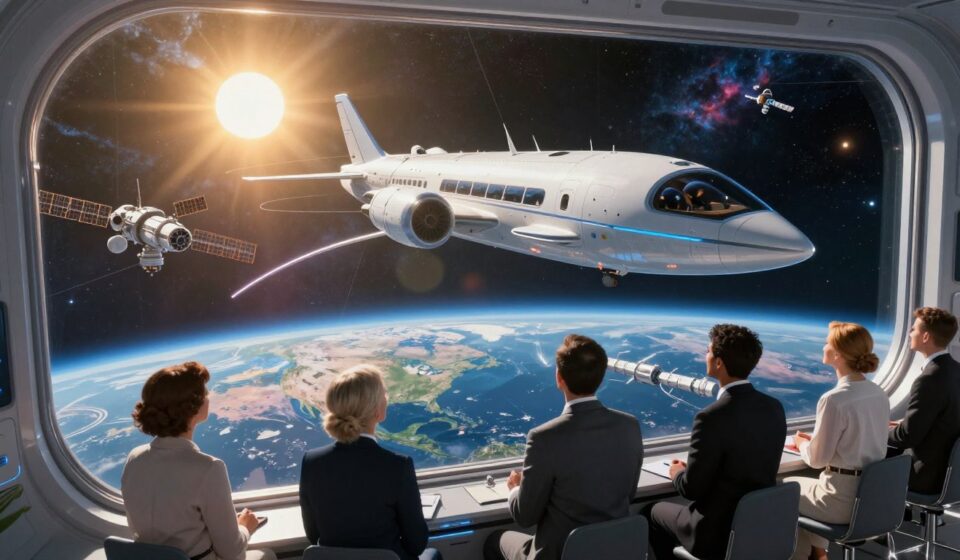
Space Exploration in 2026: How Humanity’s Journey Beyond Earth Is Shaping the Future

Space Exploration in 2026: How Humanity’s Journey Beyond Earth Is Shaping the Future
The year 2026 is poised to be a landmark year for humanity’s endeavors beyond Earth’s atmosphere. Since 2023, numerous significant milestones have been achieved in space travel, redefining the future of our planet and beyond.
As we continue to push the boundaries of space exploration, exciting developments are on the horizon. These advancements are not only enhancing our understanding of the universe but also paving the way for new opportunities in the future of space.
The upcoming year promises to be pivotal, with various missions and technological innovations set to redefine the landscape of space travel. This article will delve into the key themes and advancements that are shaping the future of humanity’s journey beyond Earth.
Key Takeaways
The significance of 2026 in the context of space travel advancements.
Overview of the key themes to be discussed in the article.
Insights into the future of humanity’s journey beyond Earth.
The role of technological innovations in shaping space exploration.
The potential impact of these developments on our understanding of the universe.
The New Era of Space Exploration in 2026
The year 2026 marks a new era in space exploration, with humanity poised to make significant strides beyond Earth’s orbit. This new era is characterized by rapid advancements in technology, strategic mission planning, and a renewed focus on Mars colonization.
Significant achievements since 2023 have laid the groundwork for the current state of space exploration. Let’s examine some of these milestones.
Milestone Achievements Since 2023
Since 2023, numerous milestone achievements have propelled humanity into a new era of space travel. Notably, NASA’s Artemis program has made significant progress, with successful lunar missions paving the way for future space exploration endeavors. Additionally, private companies like SpaceX and Blue Origin have continued to push the boundaries of space technology, with innovative solutions for mission planning and execution.
Shifting Paradigms in Mission Planning and Execution
The landscape of mission planning and execution has undergone a significant shift in recent years. Advanced technologies, such as AI and autonomous systems, have enabled more efficient and effective space missions. Furthermore, the increasing importance of international collaboration has led to the development of more comprehensive and sustainable mission plans. This shift is crucial for the success of long-term missions, such as those aimed at Mars colonization.
As we move forward, these advancements will continue to shape the future of space exploration, enabling humanity to explore and settle new worlds.
Key Players Redefining the Cosmic Landscape
In the rapidly evolving world of space travel, several key organizations are making significant strides, redefining what’s possible beyond Earth’s atmosphere. These players are not only advancing technological capabilities but also fostering a new era of cooperation and competition in space exploration.
NASA’s Strategic Vision and Current Missions
NASA continues to be a leading force in space exploration, with a strategic vision focused on returning humans to the Moon and eventually sending them to Mars. Current missions, such as the Artemis program, are pivotal in achieving these goals. Artemis aims to establish a sustainable presence on the lunar surface, serving as a stepping stone for deeper space missions.
The agency is also investing in cutting-edge technologies, including advanced propulsion systems and lunar landers, to support its ambitious plans.
SpaceX, Blue Origin, and Other Commercial Pioneers
Commercial entities like SpaceX and Blue Origin are revolutionizing space travel with innovative technologies and entrepreneurial spirit. SpaceX’s Starship program is designed for lunar and Mars missions, with significant progress made in reusable launch vehicles. Blue Origin’s New Glenn rocket and lunar lander initiatives are also noteworthy, contributing to a competitive landscape that drives progress.
International Collaboration: ESA, CNSA, ISRO, and JAXA
International collaboration is a cornerstone of modern space exploration. Agencies like the European Space Agency (ESA), China’s National Space Administration (CNSA), the Indian Space Research Organisation (ISRO), and Japan’s Aerospace Exploration Agency (JAXA) are working together on various projects, sharing resources and expertise. For instance, the ESA and NASA are collaborating on the Artemis program, while CNSA is pursuing its own lunar and Mars exploration initiatives.
Space AgencyNotable ProjectsCollaborationsNASAArtemis Program, Mars ExplorationESA, SpaceXSpaceXStarship, Reusable Launch VehiclesNASA, Private ClientsESALunar Lander, Mars ExplorationNASA, CNSA
As these key players continue to push the boundaries of space exploration, their efforts are likely to yield significant advancements in the coming years, shaping the future of humanity’s presence in space.
Mars Colonization: The 2026 Reality
Mars colonization is on the cusp of becoming a reality in 2026, with several key developments paving the way for human habitation. The prospect of establishing a human settlement on Mars has garnered significant attention, driven by advancements in technology and our understanding of the Martian environment.
First Permanent Habitation Modules on the Red Planet
The establishment of the first permanent habitation modules on Mars is a critical step towards colonization. These modules are designed to provide a safe and sustainable living environment for the initial wave of settlers. Inflatable habitats and prefabricated modules are among the designs being considered for their ability to offer ample space while minimizing transportation costs.
“The key to successful Mars colonization lies in creating habitats that can sustain life for extended periods, leveraging local resources whenever possible.”
Life Support Technologies for Martian Conditions
Developing life support technologies capable of sustaining human life on Mars is a complex challenge. The Martian environment is harsh, with extreme temperatures, low air pressure, and a toxic atmosphere. Atmospheric processing and water recycling are crucial technologies being developed to support human life. These systems will be essential for creating a self-sustaining presence on Mars.
TechnologyDescriptionImportanceAtmospheric ProcessingConverting Martian atmosphere into breathable airHighWater RecyclingRecycling water for consumption and other usesHighFood ProductionHydroponics and aeroponics for food supplyMedium
Resource Utilization and Self-Sustainability Efforts
Resource utilization is a cornerstone of Mars colonization, enabling settlers to harness local resources to sustain their presence. In-situ resource utilization (ISRU) is a key strategy, involving the extraction of water from Martian soil or atmosphere, which can then be used for life support, propulsion, and other purposes. This approach is vital for reducing reliance on Earth-based supplies and fostering self-sustainability.
As we move towards establishing a human settlement on Mars, the integration of these technologies and strategies will be crucial. The journey to Mars colonization is complex, but with continued innovation and investment, 2026 is set to be a pivotal year in this endeavor.
Lunar Base Development and Operations
With the Artemis program at the forefront, lunar base development is gaining momentum, promising a new era in space habitation. The moon is set to become a crucial hub for space exploration, serving as a stepping stone for missions to Mars and beyond.
Artemis Program’s Established Presence
The Artemis program has made significant strides in establishing a human presence on the lunar surface. NASA’s efforts to return humans to the moon by 2025 are on track, with the aim of creating a sustainable presence on the lunar surface. As Jeffrey DeGraw, NASA’s Deputy Associate Administrator for Exploration Systems Development, noted, “The Artemis program is not just about returning to the moon; it’s about establishing a sustainable presence that will enable us to explore deeper into the solar system.”
Lunar Gateway as the Stepping Stone to Deep Space
The Lunar Gateway, a key component of the Artemis program, is being developed as a crucial stepping stone for deep space missions. This orbiting lunar outpost will serve as a base for scientific research, technological development, and a staging point for missions to the lunar surface and beyond. As Dr. Lisa Campbell, NASA’s Acting Deputy Associate Administrator for Exploration Systems, emphasized, “The Lunar Gateway is pivotal in our strategy to expand human presence into the solar system.”
Commercial Mining and Manufacturing on the Moon
As the lunar base develops, commercial activities such as mining and manufacturing are expected to emerge. Companies like Shackleton Energy Company and Planetary Resources are already exploring the potential for lunar resource utilization. The moon’s resources, including water ice, could be exploited to produce fuel, oxygen, and other essential resources, supporting both lunar and deep space missions.
The development of a lunar base is a complex endeavor that involves international cooperation, technological innovation, and significant investment. However, the potential rewards are substantial, ranging from enhanced scientific understanding to the creation of new industries and resources.
Revolutionary Technologies Transforming Space Exploration
As we continue to push the boundaries of space exploration, 2026 brings forth a new era of technological innovations that are redefining our presence in space. The advancements in various fields are not only enhancing our capabilities but also making space travel more sustainable and accessible.
Next-Generation Propulsion Systems
The development of next-generation propulsion systems is crucial for deeper space exploration. Technologies such as nuclear propulsion and advanced ion engines are being refined to provide more efficient and powerful propulsion, enabling spacecraft to travel farther and faster.
Advanced Habitat and Life Support Solutions
Advanced habitat and life support solutions are vital for sustaining long-duration missions. Innovations in closed-loop life support systems and inflatable space habitats are providing astronauts with safer and more comfortable living conditions in space.
Radiation Shielding Breakthroughs
Radiation shielding is a critical challenge for deep space missions. Recent breakthroughs in lightweight radiation shielding materials and inflatable shielding technologies are offering promising solutions to protect both astronauts and electronic systems from harmful cosmic radiation.
AI and Autonomous Systems in Space Operations
The integration of AI and autonomous systems is revolutionizing space operations. These technologies enable spacecraft to make real-time decisions, perform complex tasks, and operate with greater autonomy, reducing the need for constant human intervention.
In conclusion, the revolutionary technologies emerging in 2026 are transforming the landscape of space exploration. By advancing propulsion systems, habitat solutions, radiation shielding, and AI capabilities, we are poised to achieve greater milestones in space.
The Trillion-Dollar Space Economy of 2026
As we venture into 2026, the space economy is poised to reach a trillion-dollar milestone. This significant growth is driven by emerging industries and technological advancements that are transforming the way we explore and utilize space.
Orbital Manufacturing and Zero-G Industries
Orbital manufacturing and zero-G industries are revolutionizing the production of goods in space. Companies like Varda Space Industries and Nanowave Technologies are pioneering the development of manufacturing facilities in orbit, leveraging the unique microgravity environment to create high-quality materials and products. According to industry experts, “the in-orbit manufacturing market is expected to grow exponentially, driven by demand for advanced materials and pharmaceuticals produced in microgravity.”
Satellite Networks and Global Connectivity
The growth of satellite networks is another key driver of the space economy. Companies such as SpaceX with its Starlink constellation and Amazon’s Kuiper Systems are deploying vast networks of satellites to provide global internet connectivity. This not only bridges the digital divide but also enables a wide range of services, from remote healthcare to financial transactions in previously inaccessible regions.
Investment Landscapes and Emerging Markets
The investment landscape in the space economy is evolving rapidly, with new markets and opportunities emerging. Venture capitalists and private equity firms are increasingly investing in space-related startups, driving innovation and growth. As noted by a leading space industry analyst, “the space economy is becoming more accessible to investors, with a growing number of opportunities in satellite services, space tourism, and beyond.”
Space Tourism: From Luxury to Accessibility
Space tourism is undergoing a dramatic shift in 2026, evolving from a costly, elite activity to a more inclusive and accessible venture. This transformation is driven by advancements in technology, infrastructure development, and a growing interest in space travel.
Orbital Hotels and Extended Space Stays
The concept of orbital hotels is becoming a reality, with companies like Orion Span and Bigelow Aerospace pioneering the development of space-based habitats. These orbital hotels will offer extended stays, allowing tourists to experience life in space for longer periods.
Extended space stays will enable tourists to acclimate to the microgravity environment, participate in space-based activities, and enjoy the unique experience of living in space. The infrastructure for these hotels is being designed with comfort and safety in mind, ensuring a pleasant stay for visitors.
Lunar Excursions for Civilian Travelers
Lunar excursions are set to become a new frontier in space tourism, with companies like SpaceX and Blue Origin planning to send civilian travelers to the Moon. These excursions will offer a unique opportunity to experience the lunar surface, conduct moonwalks, and witness the Earth from a distant perspective.
The development of reusable lunar landers and advanced life support systems is crucial for making lunar excursions safe and accessible. As technology advances, the cost and complexity of these missions are expected to decrease, making them more viable for a broader audience.
Declining Costs and Broadening Demographics
As the space tourism industry continues to evolve, costs are declining, making it more accessible to a wider demographic. Advances in technology, economies of scale, and increased competition are driving down prices, enabling more people to participate in space travel.
The broadening demographics of space tourists will have a significant impact on the industry, driving demand for diverse services and experiences. As the industry grows, we can expect to see more tailored packages and services catering to different age groups, interests, and abilities.
YearSpace Tourism Market SizeProjected Growth Rate2026$1.2 Billion15%2027$1.4 Billion18%2028$1.7 Billion20%
Scientific Discoveries Reshaping Our Cosmic Understanding
Scientific discoveries in 2026 are revolutionizing our knowledge of the universe, from exoplanet analysis to astrobiology research. As we continue to explore the cosmos, new findings are providing unprecedented insights into the nature of our universe.
Exoplanet Atmospheric Analysis and Habitability Findings
Recent studies on exoplanet atmospheres have revealed crucial details about their composition and potential habitability. Advanced spectrographic instruments have enabled scientists to analyze the atmospheric conditions of distant planets, identifying key biomarkers.
For instance, the discovery of oxygen and methane in the atmosphere of an exoplanet could indicate biological activity. Such findings are crucial in the search for life beyond Earth.
Deep Space Telescopes and Cosmological Revelations
Deep space telescopes have been instrumental in uncovering the secrets of the universe. The latest generation of telescopes, such as the James Webb Space Telescope, has provided breathtaking images and valuable data about the formation of galaxies and stars.
These telescopes are capable of observing distant galaxies, shedding light on the early universe and the processes that shaped it.
Astrobiology Research and Potential Biosignatures
Astrobiology research focuses on the conditions necessary for life to exist elsewhere in the universe. Scientists are investigating potential biosignatures, such as the presence of certain gases in a planet’s atmosphere, that could indicate life.
BiosignatureDescriptionImplicationOxygenPresence of oxygen in atmospherePossible indication of photosynthetic lifeMethanePresence of methane in atmosphereCould indicate microbial lifePhosphinePresence of phosphine in atmospherePotential indicator of biological activity
Ethical and Practical Challenges in Modern Space Exploration
As space exploration advances, humanity faces a new set of challenges that are as much ethical as they are practical. The increasing complexity of space missions has brought to the forefront issues that were previously secondary to the primary goal of exploring space.
Orbital Debris Mitigation Strategies
The accumulation of debris in Earth’s orbit poses significant risks to operational spacecraft and satellites. Effective mitigation strategies are crucial, including the development of technologies to remove debris and regulations to prevent further accumulation.
StrategyDescriptionImplementation TimelineDebris Removal TechnologiesDevelopment of spacecraft designed to capture and remove debris from orbit2026-2030Regulatory FrameworksEstablishment of international regulations to limit debris creation2025-2028
Planetary Protection and Contamination Concerns
As we explore and potentially colonize other planets, the risk of contaminating these environments with Earth-based organisms becomes a significant concern. Robust protocols are needed to prevent biological contamination.
“The protection of planetary environments is not just a scientific imperative, but an ethical one as well.”
Evolving Space Law and Resource Rights
The increasing commercialization of space necessitates a reevaluation of existing space law. Clarifying resource rights and establishing legal frameworks for space mining and other activities is essential.
Ethical Frameworks for Space Colonization
As humanity considers colonizing other planets, ethical frameworks must be developed to guide these efforts. This includes considering the rights of potential colonizers and the ethical implications of establishing new societies.
Conclusion: Charting Humanity’s Course Among the Stars
As we navigate through 2026, it’s clear that space exploration has reached a pivotal moment. With NASA, SpaceX, Blue Origin, and other key players pushing the boundaries, the future of space exploration is brighter than ever. The establishment of permanent habitation modules on Mars, the development of the Lunar Gateway, and advancements in revolutionary technologies are charting humanity’s course among the stars.
The trillion-dollar space economy is emerging, driven by orbital manufacturing, satellite networks, and a growing space tourism industry. As we look to the future, it’s essential to address the ethical and practical challenges that come with space exploration, including orbital debris mitigation and planetary protection.
With international collaboration and continued innovation, humanity is poised to make significant strides in space. The journey ahead will be complex, but the potential for discovery and growth is vast. As we continue to explore and expand our presence in space, we are not only shaping the future of space exploration but also ensuring a bright future for humanity among the stars.
FAQ
What are the major milestones achieved in space exploration since 2023?
Since 2023, significant milestones have been achieved, including the establishment of the first permanent habitation modules on Mars, advancements in lunar base development through the Artemis program, and breakthroughs in revolutionary technologies such as next-generation propulsion systems and advanced life support solutions.How is NASA contributing to the new era of space exploration in 2026?
NASA is playing a crucial role in the new era of space exploration through its strategic vision and current missions, including the Artemis program aimed at establishing a sustainable presence on the Moon and eventually sending humans to Mars.What role do commercial entities like SpaceX and Blue Origin play in advancing space travel?
Commercial entities like SpaceX and Blue Origin are pioneering advancements in space technology, including reusable rockets, lunar missions, and the development of next-generation propulsion systems, significantly contributing to the progress in space exploration.How is international collaboration impacting space exploration?
International collaboration among space agencies such as NASA, ESA, CNSA, ISRO, and JAXA is crucial for advancing space exploration, enabling the sharing of resources, expertise, and risk, and driving progress in space travel through joint missions and initiatives.What are the challenges facing Mars colonization efforts?
Mars colonization efforts face several challenges, including the development of reliable life support technologies, resource utilization, and self-sustainability, as well as addressing the psychological and physical impacts of long-duration spaceflight on astronauts.How is the Lunar Gateway contributing to deep space exploration?
The Lunar Gateway serves as a stepping stone to deep space, providing a platform for scientific research, technological development, and exploration, and enabling missions to the Moon’s surface and beyond, including Mars.What is the significance of the trillion-dollar space economy in 2026?
The trillion-dollar space economy represents a significant shift in the economic landscape, driven by emerging industries such as orbital manufacturing, satellite networks, and space tourism, presenting new opportunities and challenges for investment, innovation, and growth.How is space tourism evolving in terms of accessibility?
Space tourism is becoming more accessible due to declining costs, advancements in technology, and the development of orbital hotels and lunar excursions, broadening the demographics of space travelers and transforming the industry.What are the key scientific discoveries reshaping our understanding of the cosmos?
Key scientific discoveries, including exoplanet atmospheric analysis, deep space telescope revelations, and astrobiology research, are significantly advancing our understanding of the universe, revealing new insights into the potential for life beyond Earth and the nature of the cosmos.What are the ethical and practical challenges in modern space exploration?
Modern space exploration faces ethical and practical challenges, including orbital debris mitigation, planetary protection, evolving space law, and the need for ethical frameworks for space colonization, requiring careful consideration and cooperation to ensure sustainable and responsible space activities.